Childcare IQ
A market-intelligence platform for childcare-center site selection. It scans an entire state on a one-mile grid, scores every point by unmet demand using census demographics and nearby competitive supply, and ranks the best underserved markets.
What it does
Childcare IQ is a market-intelligence platform for childcare-center site selection and competitive benchmarking, built around three questions a growing operator actually asks:
- Where in this state is premium childcare undersupplied relative to demand?
- Is this specific address a viable location?
- How do our existing locations compare to competitors on market quality?
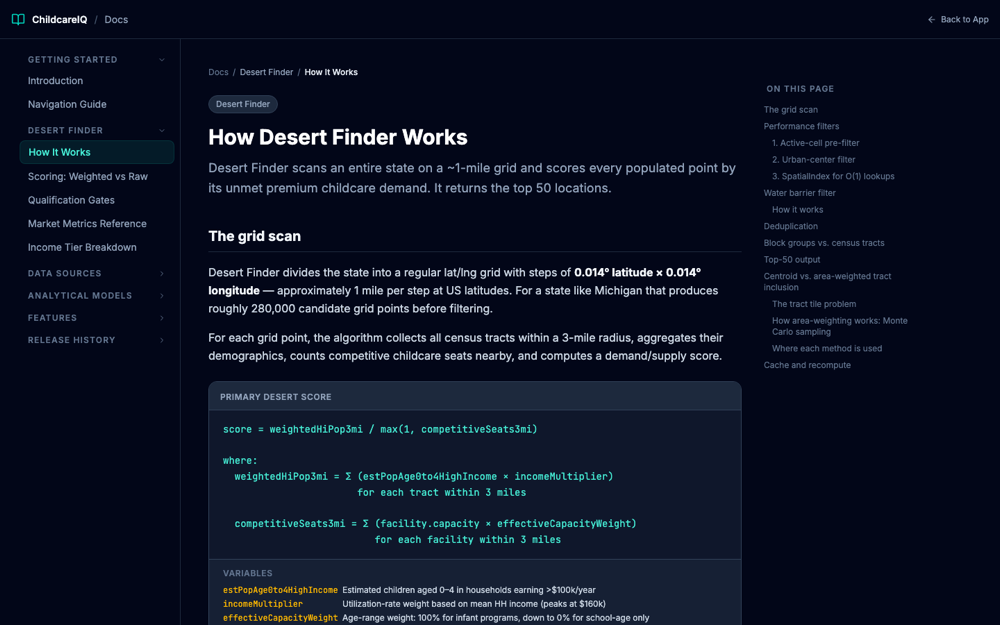
The first question is answered by Desert Finder, the platform’s core algorithm: it divides an entire state into a roughly one-mile grid — about 280,000 candidate points for a state the size of Michigan — and scores every populated point by unmet demand. The scoring formula weighs estimated high-income population with children aged 0–4 within a three-mile radius against nearby competitive seat capacity, then returns the top 50 underserved locations. Clicking any point on the resulting map scores it directly against census demographics and competitive supply. A separate Market Intelligence module handles brand-level competitive landscape, reputation analysis, and growth opportunities across a market, and a Childcare CFO module adds financial benchmarking and pro forma modeling.
How it’s built
The frontend is React 19 with TypeScript on Vite, styled with Tailwind 4 and Radix UI primitives, with Zustand for state and Recharts for the financial dashboards. Mapping runs on Leaflet with clustering and heatmap layers. Supabase handles auth and the backing database.
The real work is in the data pipeline: a set of TypeScript scripts geocode and normalize U.S. Census population and block-group data across nine states (Michigan, Pennsylvania, New Jersey, Texas, New York, California, Colorado, Massachusetts, Georgia), cross-reference it against Zillow housing data, and run regression analysis to weight the demand model. All of that gets pre-computed into the grid that Desert Finder scans at request time, which is why a full-state scan returns in seconds rather than running census queries live.